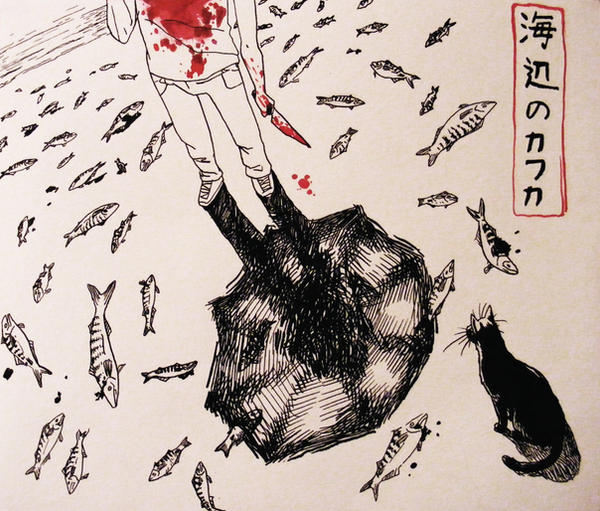
Even the most novice literary critic no longer looks for narrative but rather examines the form of a text. Although this can be a daunting task for the reader, great authors often assist in the enterprise by teaching her how to read the work at hand. Prominent Modernist or Postmodern novelists often instruct their readers on how to make contact with the text, but Murakami in Kafka on the Shore carries the heavier burden of instructing the reader on how to read a genre.
Kafka on the Shore teaches us how to read Kafka. The Kafkaesque style of narration relies on a seamless combination of dark comedy and an uncannily familiar absurdism. Many readers of the early twentieth century Czech-German writer, including David Foster Wallace (see "Some Remarks on Kafka's Funniness" in Consider the Lobster: And Other Essays), have noted that the Kafkaesque style very fundamentally depends on the literalization of metaphor. Like Wallace does, we can take Kafka's short story "The Hunger Artist" as an example. This story follows a man who starves himself to establish a career as a performance artist. A reading of this text raises the question of how "hunger" as an abstract concept operates in metaphor-- and the theoretical illuminations that occur in its materialization and literalization. What does it mean to be "hungry for attention" and etc.? With these introductory notes on Kafka in mind, we can effectively approach Murakami's eponymous and stylistically related text. Murakami uses his protagonist Kafka Tamura as a proxy to navigate the reader through a world where typically abstract and metaphoric phenomena exist in a very material, literal, and even preconscious form.
This being said, The New Yorker's note of praise printed on the back of my copy of Kafka on the Shore, "An insistently metaphysical [italics mine] mind-bender", seems almost comically irrelevant. Like the work of Kafka, Murakami's novel transforms the abstract into materiality. For Kafka on the Shore, however, this economy produces the side effect of simulacra-- physical objects or phenomena that have severed all ties with their conceptual origin. The most obvious simulacra within this text originate from Western consumer and literary culture. First we have the characters of Johnny Walker and Colonel Sanders, two imaginary figures borrowed from the West. These abstract representatives have been turned real and also disconnected from their respective corporate interests. The third simulacrum is the name Kafka itself. The text reveals that the term Kafka translates into "crow". The text leaves no space for translational inference-- it the Boy Named Crow inhabits the narrative space. The text thus amputates the metaphoric suggestiveness of the name Kafka and replaces it with a real character who possesses a translated, concrete version of the name.
The final and most important simulacrum of this text is the Oedipus Complex. This Freudian construct exits a merely conceptual space and materializes within the narrative. In a universe where the traumatic Oedipus Complex not only exists but also unfolds, the text teaches the reader to accept the Kafkaesque style through the character of Kafka Tamura. The unsolved murder of Kafka's father leaves behind more riddles than solutions. But the Oedipus Complex doesn't reside as a phantom that haunts this text. Kafka on the Shore only leaves two possibilities: the full, brutal presence of the Oedipal drive or its complete absence. As a boy who inhabits a world filled with materialized abstractions from popular culture, Kafka ultimately learns to accept this quality of the Kafkaesque. The language of Franz Kafka is often described as the language of the preconscious, a language that is raw and unbeautified by the linguistic methods of consciousness. Kafka Tamura thus teaches us to inhabit the preconscious space, one that lacks the tools necessary to construct abstraction.

No comments:
Post a Comment