With the recent events surrounding Pussy Riot, the Russian punk band that was sentenced to two years in prison for the public performance of a "punk prayer," I've been thinking much about the present state of political activism. And by "thinking much" I mean constructing questionable generalizations. That being said, I'm very interested in the structural similarities between the comic and the political, and I believe that three recent prominent cases of political activism have produced comedy or irony as a side-effect. Or maybe the comic is more than a byproduct and rather a crucial element of the activism. These three cases come from American, international, and personal spheres, respectively.
1. The Occupy Movement
We start with the political movement that needs no introduction. At its worst, the Occupy Movement consisted of a group of pseudo-intellectual twenty-somethings making a mess in the streets of New York City. At its best, however, the country's 99% was engaged in a sort of meta-activism-- i.e. political activism that was about political activism. For the Occupy Movement to succeed, it necessarily had to fail. The basic argument of the Occupy Movement was that the 99% had no power. If the Occupy Movement had succeeded and had achieved all of its poorly defined goals, the 99% would have proven that it does indeed have some influence over politics thereby disproving its original premise. Structurally, we can compare this to the archetypal scene from comedy where a haughty bourgeois man is walking down the street and he slips on a banana peel, consequently demonstrating his unexceptional humanity. However, as Alenka Zupancic argues, the comedy here doesn't stem from the man's transformation from a gentleman into a simpleton as the result of the fall. The comedy is rather produced as a result of an exposure of the pompous man's humanity. The comedy is not that this arrogant man has slipped like a fool-- the comedy is that man was a fool to begin with and that the banana peel only exposed the supposed gentleman's true character. It could be said that the man's false sense of superiority is just as foolish as the act of slipping on a banana peel. Returning to the discussion of the Occupy Movement, the 99% and its political activism's failure is not indicative of the emergence of a new trait (political impotence), but rather the exposure of the bigger problem at hand-- the 99%'s political impotence. The Occupy Movement's imminent political failure must be interpreted as a comic symptom of contemporary activism and not as the genesis of a new quality of the 99% status in American democracy.
2. Pussy Riot
The dynamic of the political drama surrounding Pussy Riot also has comic potential. It seems to me we have three players: Pussy Riot (and the public the band represents), the Russian government, and the Orthodox Church that is serving as a mediator between these two opponents. Pussy Riot's actions can at the worst be interpreted naïvely as typical aggression towards the Russian state expressed through medium of music. However, it can also be interpreted as a sort of meta-activism like the Occupy Movement. Much of the band's supporters' discontent emerged not from the conviction itself but from the extremity of the sentence. It is almost as if Pussy Riot's actions served as a test-- not of whether the Russian government would react but how it would respond to the activism. Thus, Pussy Riot's "punk prayer" was not activism for activism's sake-- it had the greater of agenda of demonstrating corruption and injustice of the judicial system. However, this economy of producing unfair sentences through using political activism as a litmus test utilizes the Orthodox church as a type of mediator. The Church serves as a medium in which the political activism occurs and thus as supplementary justification for the government's severe sentence. Pussy Riot and the Russian government can be perceived as false doubles within this dynamic-- as one party attempts to carry out a reciprocal response to the actions of the other. Here the comedy emerges. The comedy of doubles, as Alenka Zupancic has astutely noted, recalls for the nerdier reader Shakespeare's Comedy of Errors and Molière's The Miser. But for the most lucid example possible, we can turn to the famous mirror scene in The Marx Brothers' Duck Soup (1933). In this perhaps needlessly elaborate analogy, the Church represents the mirror that has been shattered as a result of the persecution of one party over the other (in the scene, one man is chasing the other). What is left is the mere phantom of a mirror-- the belief that a mirror is where it once was. We thus have two individuals reflecting each other's movements. But the medium of the mirror isn't really there. Like the absence of the actual mirror in this scene, the false medium through which Pussy Riot's and the government's political actions are transmitted must be removed from the public imagination. Using the accusation of religious disrespect creates the illusion of an accurate reflection of Pussy Riot's actions. The Church's sanctified presence justifies the extreme punishment of Pussy Riot. However, once the idea of the reflective medium is removed, we see the government's severe sentence for what it really is-- a jest; an attempt at reciprocation and mimicry that is actually slightly off.
3. The University in Crisis
I think it was the Fall of this past school year when I attended a rally/protest against my university's budget cuts. Following a walk around campus the chanting, sign-carrying group of protesters concluded the rally with an open-mic session held directly outside of the administration building. Any and all participants were invited to take the megaphone and speak if they desired. Following a series of very astute speakers who commented on the injustice of the UC Regents, the final speaker was a grad student in his late-twenties. He was a PhD student in Computer Science (and you thought you had problems) and he began listing statistics that illustrated the staggering decline in value of a university education. He also used his own unfortunate financial/professional situation in an attempt to relate to the crowd. He was eloquent and his sources seemed legitimate, but as soon as he explicitly began to encourage the listeners to drop out of college, the audience began to aggressively boo this speaker. Although the boo-ing was done in good taste, and many of those teasing him were friends and colleagues, I couldn't help but feel bad for the guy in a way. But his speech clearly indicated the rhetorical limits of this activist movement-- limits that produced a comic situation. Samuel Beckett once said, "There is nothing funnier than the unhappy." I don't think he meant it in a cruel way, though. I think Beckett's understanding of the unhappy can be described as the misfitting-- the unahappy, for Beckett, is that which doesn't fit. This graduate student's poverty and his professional gridlock are tragedies in themselves. He clearly didn't fit (or at least didn't want to) into his present academic and professional situation. But when he attempted to express his unhappiness during this forum, he was again treated as a misfit within a community of similarly discontented students. I admit, this case study isn't as well thought out as it should be-- but it seems to me that although the present crisis in higher education is tragic, it produces a comedy of misfits. But what will this collective misfits produce? Can political activism be understood simply as a comedy of misfits? Are the ironies emerging from this comedy of misfits viable weapons for the political activist?
Sunday, August 19, 2012

Thursday, August 16, 2012
Kafka on the Shore by Haruki Murakami: A Tutorial on Encountering the Kafkaesque
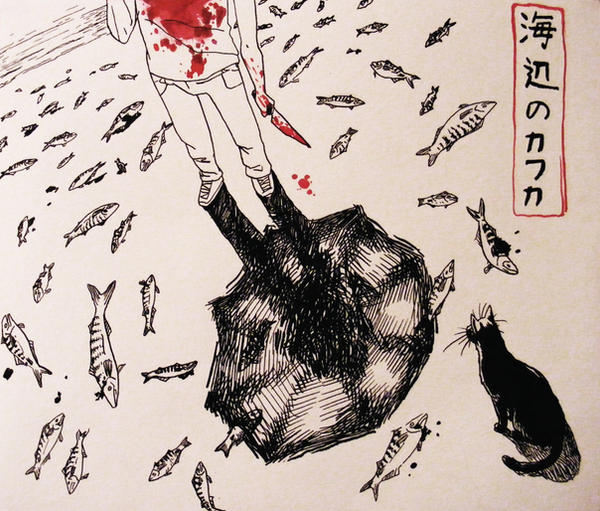
Even the most novice literary critic no longer looks for narrative but rather examines the form of a text. Although this can be a daunting task for the reader, great authors often assist in the enterprise by teaching her how to read the work at hand. Prominent Modernist or Postmodern novelists often instruct their readers on how to make contact with the text, but Murakami in Kafka on the Shore carries the heavier burden of instructing the reader on how to read a genre.
Kafka on the Shore teaches us how to read Kafka. The Kafkaesque style of narration relies on a seamless combination of dark comedy and an uncannily familiar absurdism. Many readers of the early twentieth century Czech-German writer, including David Foster Wallace (see "Some Remarks on Kafka's Funniness" in Consider the Lobster: And Other Essays), have noted that the Kafkaesque style very fundamentally depends on the literalization of metaphor. Like Wallace does, we can take Kafka's short story "The Hunger Artist" as an example. This story follows a man who starves himself to establish a career as a performance artist. A reading of this text raises the question of how "hunger" as an abstract concept operates in metaphor-- and the theoretical illuminations that occur in its materialization and literalization. What does it mean to be "hungry for attention" and etc.? With these introductory notes on Kafka in mind, we can effectively approach Murakami's eponymous and stylistically related text. Murakami uses his protagonist Kafka Tamura as a proxy to navigate the reader through a world where typically abstract and metaphoric phenomena exist in a very material, literal, and even preconscious form.
This being said, The New Yorker's note of praise printed on the back of my copy of Kafka on the Shore, "An insistently metaphysical [italics mine] mind-bender", seems almost comically irrelevant. Like the work of Kafka, Murakami's novel transforms the abstract into materiality. For Kafka on the Shore, however, this economy produces the side effect of simulacra-- physical objects or phenomena that have severed all ties with their conceptual origin. The most obvious simulacra within this text originate from Western consumer and literary culture. First we have the characters of Johnny Walker and Colonel Sanders, two imaginary figures borrowed from the West. These abstract representatives have been turned real and also disconnected from their respective corporate interests. The third simulacrum is the name Kafka itself. The text reveals that the term Kafka translates into "crow". The text leaves no space for translational inference-- it the Boy Named Crow inhabits the narrative space. The text thus amputates the metaphoric suggestiveness of the name Kafka and replaces it with a real character who possesses a translated, concrete version of the name.
The final and most important simulacrum of this text is the Oedipus Complex. This Freudian construct exits a merely conceptual space and materializes within the narrative. In a universe where the traumatic Oedipus Complex not only exists but also unfolds, the text teaches the reader to accept the Kafkaesque style through the character of Kafka Tamura. The unsolved murder of Kafka's father leaves behind more riddles than solutions. But the Oedipus Complex doesn't reside as a phantom that haunts this text. Kafka on the Shore only leaves two possibilities: the full, brutal presence of the Oedipal drive or its complete absence. As a boy who inhabits a world filled with materialized abstractions from popular culture, Kafka ultimately learns to accept this quality of the Kafkaesque. The language of Franz Kafka is often described as the language of the preconscious, a language that is raw and unbeautified by the linguistic methods of consciousness. Kafka Tamura thus teaches us to inhabit the preconscious space, one that lacks the tools necessary to construct abstraction.
Subscribe to:
Posts (Atom)